
The two fatal train accidents that occurred in Andalusia and then in Catalonia, along with the growing number of railway malfunctions, have reignited the debate in Spain about the use of IoT technologies for continuous infrastructure monitoring. The partial derailment of an Iryo train near Adamuz, followed a few days later by a fatal collision in Catalonia after a wall collapsed onto the track, highlights the difficulty of detecting localized defects in the track or its surrounding environment in advance.
A problem of data capillarity
While the two events are distinct, they reveal a common weakness: railway infrastructures today produce very little real-time structural data. Scheduled inspections, audits, or technical rounds generate point indicators, but not continuous exploitable flows. As a result, the understanding of dynamic phenomena: lateral movements, thermal expansions, material fatigue, water instabilities, often occurs after an incident rather than proactively.
In other industrial sectors (energy, buildings, civil engineering), structural IoT has already shifted corrective maintenance to predictive maintenance, thanks to the installation of sensors at sensitive points and real-time analysis of the collected data. In the railway sector, this shift is more recent, even as the railway accumulates significant mechanical, environmental, and regulatory constraints.
Towards distributed monitoring on the track
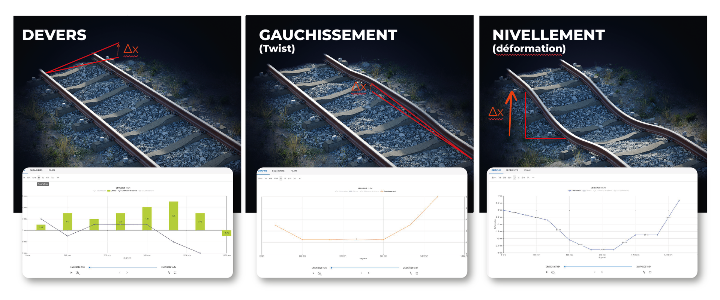
The trend observed in Europe is the proliferation of distributed sensors along the track, capable of measuring gauge, leveling, twisting, and cant. This data can then be cross-referenced with environmental parameters (temperature, humidity, rainfall, vibrations), allowing for dynamic diagnostics and the generation of alert thresholds.
Solutions such as those developed by FEELBAT illustrate this approach. The company uses connected IoT sensors: DELTA R for bi-axial inclinations, DELTA L+ for rail displacement monitoring, as well as modular inclinometric lines enabling continuous monitoring of structural deformations. Sigfox or 4G systems ensure real-time data reporting, while analysis platforms centralize the measurements to identify trends, trigger alert thresholds (SMS, email), and correlate temperature variations with observed micro-deformati
The company is also preparing to launch the DELTA V sensor, dedicated to monitoring vibrations in compliance with current local standards in order to detect precursor signals related to significant or repetitive movements.
"Networks are becoming more demanding and the margins for error are getting smaller. Real-time monitoring allows for the detection of weak signals that would otherwise be invisible. It is an additional tool to enhance safety and prevention, anticipate risks, and quickly locate failures," explains Jean-Christophe Habot, CEO of the company FEELBAT.
A strategic issue for Spanish mobility
The question now posed to the managers of the Spanish network is not whether the infrastructures need to be improved, but how they can be observed, diagnosed, and monitored more continuously. In a context where rail transport remains a pillar of Spanish mobility, the issue of structural prevention appears as an essential vector of safety.
Consulting and control offices are now advocating for the systematic integration of continuous structural monitoring technologies in areas considered sensitive.
Beyond accident prevention, the expected benefits include reducing inspection times, optimizing maintenance work, protecting operational staff, and limiting traffic disruptions.