
Can a vibration of 2 mm/s cause cracks or damage a building?
During construction, demolition, earthworks or excavation, this question regularly arises among professionals responsible for monitoring surrounding structures.
However, a vibrational speed alone is not enough to determine if a building is at risk.
The frequency of vibrations, their duration, the type of structure, and the applicable normative thresholds are all essential parameters for correctly interpreting a measurement.
So, what does a vibration of 2 mm/s actually mean? How can one know if it represents a risk? And how can reliable vibrational monitoring be ensured?
1. What does a vibration of 2 mm/s mean?
In vibrational monitoring, one of the main indicators used is the PPV (Peak Particle Velocity) or particle velocity.
Expressed in millimetres per second (mm/s), it corresponds to the maximum speed of movement of a point in the material or structure during a vibrational event.
Point of attention: a speed of 2 mm/s does not mean that the building has moved by 2 mm. It is indeed a speed, not a displacement.
The PPV allows for quantifying the vibrations generated by:
Demolition and earthworks.
Piling or compaction operations.
The passage of construction machinery and rail traffic.
Industrial activities and mechanical equipment.
Excavations and works carried out near existing structures.
However, two vibrations with the same PPV can have different effects on a building.
To understand why, we need to look at a second indicator: frequency.
2. Why is the dominant frequency as important as the PPV?
Vibrational frequency, expressed in hertz (Hz), indicates the number of oscillations made each second.
Let's take two vibrational events with exactly the same PPV of 2 mm/s:
Event A : a vibration speed of 2 mm/s at 5 Hz.
Event B : a vibration speed of 2 mm/s at 50 Hz.
The maximum measured speed is the same, but the stresses are not the same.
At equal speed, a low-frequency vibration is generally accompanied by a greater displacement amplitude than a high-frequency vibration.
Moreover, certain frequencies may approach the natural frequencies of a building or its constituent elements, leading to an amplification of the vibrational response.
This is why technical references take frequency into account to define their guideline values.
In practice, analysing only the PPV amounts to having incomplete information about the vibrational behaviour of a structure.
3. What are the acceptable vibration thresholds for a building?
There is no universal standard that can be used to determine whether a vibration is dangerous or safe for all buildings.
The reference thresholds depend notably on the nature of the structure, the measured frequencies, the type of loading, and the reference used.
The DIN 4150-3 standard
The German standard DIN 4150-3 is frequently used to assess the effects of vibrations on structures.
For short-duration vibrations measured at the foundation level, it distinguishes several categories of buildings.
For example, for frequencies between 1 and 10 Hz, the guideline values for vibration velocity are:
| Building category | Guideline value |
|---|---|
| Industrial and commercial buildings | 20 mm/s |
| Residential buildings | 5 mm/s |
| Particularly sensitive structures | 3 mm/s |
These values pertain to a specific measurement case and should not be used as general thresholds applicable to all situations.
A vibration of 2 mm/s may therefore correspond to a guideline value for a dwelling, while exceeding that set for certain sensitive structures.
The BS 7385-2 standard
The British standard BS 7385-2 also provides guideline values to assess the risk of aesthetic damage caused by vibrations.
For certain residential buildings exposed to transient vibrations, the guideline values range from 15 mm/s at 4 Hz to 50 mm/s from 40 Hz.
These values pertain to specific conditions, notably the type of structure and the measurement point.
They illustrate one essential thing: the same level of vibration is not interpreted in the same way at all frequencies.
The French circular of 23 July 1986
In France, the circular of 23 July 1986 constitutes another reference framework for the assessment of mechanical vibrations emitted into the environment by certain classified installations.
It notably takes into account :
The category of resistance of constructions.
The bands of vibrational frequencies.
The continuous or impulsive nature of the vibrations.
Its application must be assessed according to the regulatory framework of the installation concerned.
4. Can a vibration of 2 mm/s cause cracks?
A vibration reaching 2 mm/s does not automatically mean that a building will crack.
The risk depends on several factors :
The initial condition of the building. A structure already showing cracks, disorders or weaknesses may require special monitoring.
The repetition of stresses. A single vibration and repeated vibrations over several weeks do not necessarily present the same issues.
The constructive characteristics. The materials, foundations, rigidity and configuration of the building influence its response to vibrations.
The transmission conditions. The distance to the source, the nature of the soil and the soil-structure interactions can modify the vibrations actually received.
It is therefore important to distinguish between an exceedance of guideline values and actual damage.
A threshold exceedance constitutes a signal requiring verification or analysis, not automatic proof of building degradation.
5. How to correctly interpret the data from vibration monitoring?
To effectively utilise the vibration measurements from a site, several steps are essential.
1. Identify the monitored building
Determine its use, configuration, initial condition, and sensitivity to vibrations.
2. Choose the appropriate reference framework
Select the standard or applicable requirements for the project, taking into account the measurement conditions and the nature of the vibrations.
3. Measure the vibration velocity and frequency
Do not limit yourself to a maximum value: analyse the vibratory components and the characteristics of the recorded events.
4. Compare the measurements to the reference values
Identify any exceedances and examine the circumstances in which they occur.
5. Ensure ongoing monitoring over time
Observe the evolution of stresses throughout the works and have a usable history for technical analyses.
This approach allows for a transition from a simple vibration value to a genuine structural monitoring process.
6. DELTA V: measure and understand the vibrations of a building
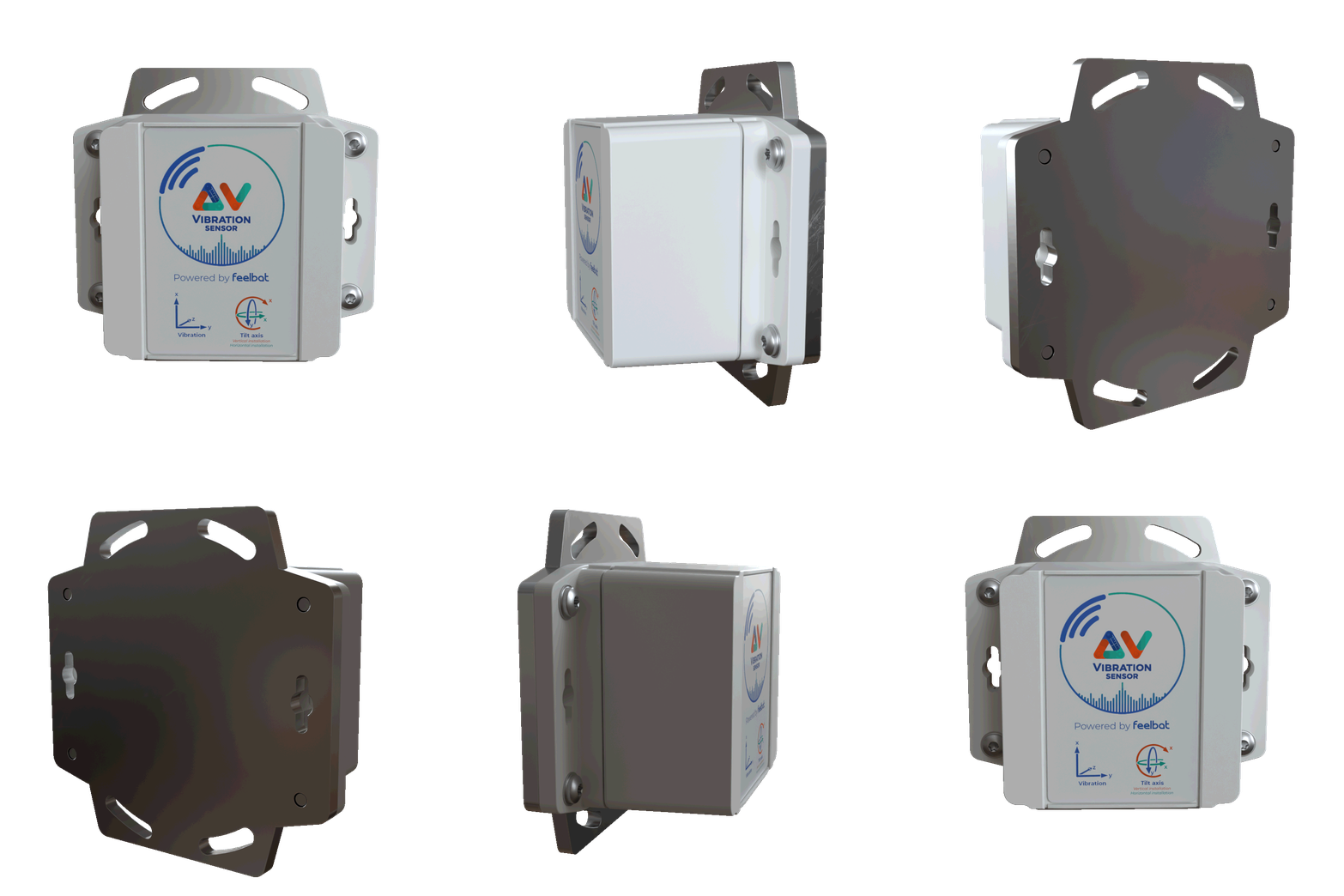
To support professionals in this process, FEELBAT has developed DELTA V, a connected sensor dedicated to vibration and structural monitoring.
In vibration mode, DELTA V allows for monitoring of:
Particle velocity (PPV) on the different axes
The dominant frequency of vibratory events.
The tilt and temperature.
The vibratory events recorded during monitoring.
The data can be accessed via the FEELBAT platform, which includes integrated standards such as DIN 4150-3, BS 7385 and the 1986 French circular.
Professionals can thus visualise their measurements, identify significant events, and facilitate their comparison to the reference thresholds appropriate for the project.
Whether to monitor a building adjacent to a construction site, accompany excavation work, or instrument a sensitive infrastructure, DELTA V allows for the centralisation of the information necessary for vibratory monitoring.
The objective: to make vibratory monitoring easier to deploy and the data easier to exploit.
Discover our sensor
Conclusion: 2 mm/s, a value to interpret, not a verdict.
So, is a vibration of 5 mm/s dangerous for a building?
Not necessarily. But it always deserves to be placed back in its context. The PPV is an essential indicator, but it must be analysed alongside the frequency, duration of the solicitations, the characteristics of the building, and the applicable thresholds.
It is this overall interpretation that allows for a better assessment of the potential effects of vibrations on structures and for making appropriate decisions.
With connected monitoring solutions like DELTA V, professionals have tools to measure, monitor, and analyse vibratory solicitations during their projects.
Sources :
- INERIS — Circular of 23 July 1986: official document on mechanical vibrations and the criteria for assessing them.
- DIN 4150-3:2016: differentiated guideline values according to building types and frequencies, distinguishing between short and long duration vibrations.
- BS 7385-2:1993 : guide values relating notably to aesthetic damage on buildings exposed to transient vibrations.