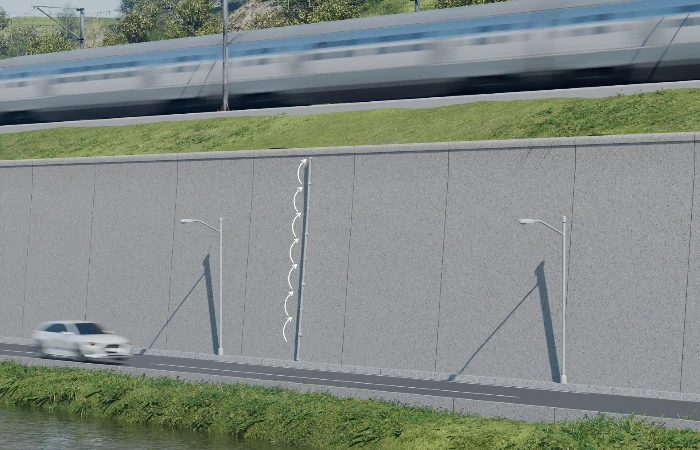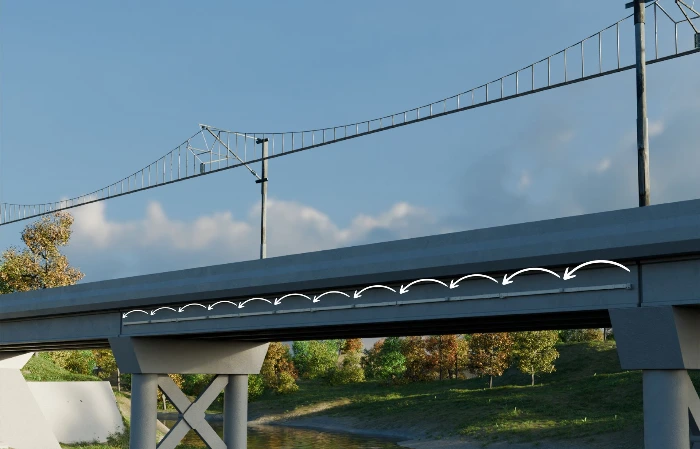
Deformation Module, structural inclinometer lines: immediately identify active areas and differential movements.
“An early detected movementcosts 5 to 10 times lessthan an emergency repair.”
The analysis of deformations in a structure or retaining wall can no longer be limited to occasional inspections or isolated measurements. Structural behaviours are generally evolving: they manifest over time through gradual variations in inclination, rotation, or relative displacement, which may lead to an increase in deflection or a change in the distribution of internal forces.
Thestructural inclinometer lineprecisely allows for this global reading.Composed of a chain of interconnected sensors, it continuously diagrams the actual evolution of the structure's behaviour. The inclination measurements are synchronised and automatically converted from degrees to millimetres, simplifying the interpretation of the data.It then becomes possible to visualise the evolution of inclinations, the relative displacement between segments, the deflection, and thus clearly identify the active areas.
The analysis becomes quick, readable and directly usable thanks to a simplified visualisation of the actual deformation. This continuous monitoring approach transforms the measurement of inclination into a decision-making tool, capable of objectifying structural changes and anticipating risks before they become critical.
An immediate visualisation of the actual deformation of the structure
Unlike a single sensor, the inclinometric line relies on a series of instrumented segments along a structural axis. Each sensor measures a local angular variation. Through successive integration, it becomes possible toreconstruct the overall deformation curveand deduce the deflection.
On a retaining wall, for example, the line allows us to identify whether the movement is uniform (global rotation) or differential (localised deformation), such as a wall that is 'bulging'.
Real-time monitoring and predictive maintenance
The major advantage of a structural inclinometric line lies in real-time monitoring. The collected data is stored historically and analysed continuously.
This timing allows for:
distinguishing a cyclic thermal phenomenon from a structural deformation,
analysing the rate of evolution of a deformation,
detecting a potential anomaly prior to an irreversible action,
Preventing in case of collapse risk
Alert thresholds can be configured according to the type of structure and the engineering criteria defined by the design office. In case of exceeding these thresholds, an automatic alert is generated, allowing for an immediate response via email and SMS.
Application on concrete cases
Saint-Nicolas Tower – La Rochelle
As part of consolidation work on this heritage structure, two inclinometers were installed to continuously measure the deformations of the masonry.
The objective was twofold:
Establish a reference state before intervention,
Differentiate natural movements (thermal expansions) from structural changes related to the work.
The inclinometer allowed for precise characterisation of daily amplitudes and adjustment of alert thresholds based on the actual behaviour of the structure.
Pharmacy floor – Rochefort
Following the installation of a heavy machine on an existing floor, a device combining an extensometer and an inclinometer was put in place.
The line allowed for monitoring the deformation of the load-bearing elements and analysing the evolution of the deflection under load. Continuous monitoring secured the operation of the building open to the public, while allowing for the anticipation of any abnormal movement through parameterised thresholds and automatic alerts.
The integration of a structural inclinometer into a global monitoring strategy thus allows for the management of structures to be framed within a predictive maintenance logic, with measurable benefits:
✔ –30 to –50% of unnecessary work, thanks to better prioritisation based on data
✔Elimination of numerous high inspections, without resorting to the rental of platforms
✔ –40% of costs related to manual inspectionsand to site security devices
✔ Significant reduction in emergency interventionsand unexpected closures
✔Extension of the lifespan of structuresthrough targeted maintenance
✔ Automatic alertsin case of threshold exceedance
FEELBAT develops IoT sensors for structural and geotechnical monitoring, ensuring continuous and remote measurement of cracks, inclinations, groundwater levels, and soil and material moisture parameters.
For more information:www.feelbat.fr